Conservation of Linear Momentum and Energy
1. A single uranium nucleus (A=238.0) spontaneously decays at rest into two Palladium Nuclei (A = 106.9). In this problem 1 A = 1.66x10⁻²⁷ kg and the mass energy + kinetic energy is conserved.
a. Make a sketch of this picture.
b. Determine the velocities of each of the Palladium nuclei.
2. A ball rolls down a frictionless slope of height h, initially at rest. The slope is on a cliff that is a height H above the ground. If the ball is allowed to roll down the slope:
a. How far from the cliff edge will the ball land?
b. How fast will the ball be traveling just before it hits the ground?
c. Recalculate a and b where the slope is carpeted and thus is has a coefficient of kinetic friction of mk. You also need to know that the incline is directed an angle q above the ground.
d. What fraction of the distance did the ball travel without friction as compared to the distance traveled with friction?
3. Suppose a ball is slid down a frictionless incline of height h, initially at rest. At the bottom of the incline it will collide with and stick to a second ball with the same mass and attatched to a massless, rigid string. The two masses will then swing as a pendulum.
a. Find the height that the balls will reach?
b. In the same scenario find the height if the ball on the plane has a mass m and the ball on the string has a mass M > m.
c. In the same scenario as b) find the height if there is friction on the surface of the incline coefficient of friction mk. You also need to know that the incline is directed an angle q above the horizontal of the top of the cliff.
d. Show that your general result in c) will give you the results of a) and b).
Potential Energy
4.
a. What is the relationship between potential energy and force?
b. Using the relationship in a) determine the potential of the given forces:
i)

ii)

iii)
 F0 is a
constant
F0 is a
constant
c. Using the potentials in b), plot each (assuming that the integration constant is zero and
i) determine the range for which a particle may be bound.
ii) determine the min/max of the total mechanical energy.
iii) locate (ie the x or r value) the min/max of the kinetic energy.
Relativity
5. What are the two postulates of the theory of relativity?
6. Determine the velocity of a particle of mass M and total energy E. At what point will the velocity of the particle be c?
7. At RHIC (Relativistic Heavy Ion Collider) where I am doing my thesis, I collide gold ions (A=197) giving each proton and neutron of the nucleus a momentum of 100 GeV/c. The mass of a proton is 0.938 GeV/c2. Determine the speed of each of these protons in the collider as a fraction of c. (Use as many digits necessary so that v doesn’t equal c.)
Center of Mass/Rotational Dynamics
8. Given the following set of particles
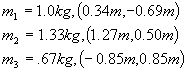
a. Find the center of mass of this system.
b. Find the moment of inertia about the center of the grid.
c. Find the moment of inertia about the center of mass using the parallel axis theorem.
9. A disk used for sharpening my sword (a grindstone) is spinning with angular velocity w0 about an axel perpendicular to the disk and through its center and has radius R and mass M. I am able to set my sword gently on the grindstone. The grindstone has a coefficient of friction mk. It rolls against the sword of mass m slowing down by friction, until it stops.
a. Determine the moment of inertia for this disk in terms of M and R.
b. Determine the torque exerted on the grindstone by the friction.
c. Determine the work done by friction to stop the grindstone from rolling.
d. Find the time that it takes to stop moving.