Particle Physics ToolsTo study the building blocks of matter, physicists collide accelerated particles. The particle accelerators work by manipulating the way charged particles feel electric and magnetic forces. · Electric forces accelerate particles.
· Magnetic forces bend and focus them into a beam. There are laboratories with high energy accelerators in the U.S.A., Europe, Russia, Japan and China. The highest beam energy of both protons and antiprotons is presently 0.95 TeV and is achieved in the Tevatron at Fermilab near Chicago, where protons and antiprotons are accelerated and collided together. When combined at the collision points, 1.9 TeV = 1.9 trillion electron volts (see box), are available to create new particles. Using this record energy, Fermilab experimenters discovered the heaviest quark the top quark.
The Large Electron Positron collider, LEP, accelerates and collides electrons and positrons (i.e. antielectrons) at a combined energy of up to 0.19 TeV at the European Laboratory for Particle Physics (CERN) near Geneva. These lepton collisions are particularly suitable for the precise study of the weak force carriers Z and W. What is an electron volt? energy of motion of a flying mosquito is about 1 TeV. This is a huge energy for a proton which is about a trillion times smaller than a mosquito. One electron volt (eV) is the energy
acquired by an electron or a proton in being
accelerated through an electric potential of one volt. A
TeV is a unit of energy used in particle physics. The
Aerial view of CERN and the surrounding region. The large circle drawn on this picture represents the underground LEP/LHC tunnel with a circumference of 27 km. The dotted line is the Swiss-French border. The long paved area in the foreground is the Geneva airport. | ||||
|
Page | ||||
|
The next step in energy is the Large Hadron Collider, LHC, due to switch on in 2005 at CERN. It will ultimately collide beams of protons at an energy of 14 TeV. Beams of lead nuclei will also be accelerated, smashing together with a collision energy of 1150 TeV.
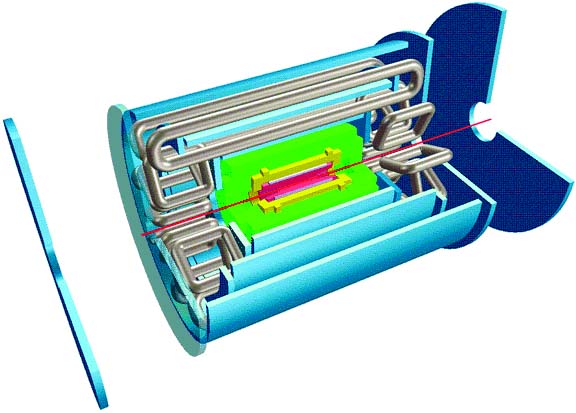
ATLAS and CMS are the two enormous detectors being built to study proton collisions at the LHC. Physicists and engineers from Nevis Labs, Columbia University, are participating in ATLAS (see picture on the right note the size of the people! ). Such detectors consist of many layers of different devices used to measure properties of the particles emerging in the collisions. Closest to the beam are tracking devices to keep tabs on the particles as they fly away from the collision. Then come energy measuring devices, calorimeters, in which most particles lose all their energy and stop. The outermost layer consists again of trackers to identify any detectable particles which get this far. Magnets embedded within the detector bend the tracks of charged particles, helping to identify and measure them. You can find more information plus links on our Web site for high school students: http://nevis1.columbia.edu/~phypharm A good way to learn about particle physics: work on the Web site "Particle Adventure" http://pdg.lbl.gov/cpep/adventure.html. We recommend you start from there. Further ReadingScientific American "The Higgs Boson" by M. J. G. Veltman, November 1986"The Stanford Linear Collider" by J. R. Rees, October 1989 "The LEP Collider" by S. Myers and E. Picasso, July 1990 "Tracking and Imaging Elementary Particles" by H. Breuker, H. Drevermann, C. Grab, A. Rademakers and H. Stone, August 1991 "The Number of Families of Matter" by G. J. Feldman and J. Steinberger, February 1991 "The Tevatron" by L. M. Lederman, March 1991 "The Silicon Microstrip Detector" by A. M. Litke and A. S. Schwarz, May 1995 "Quarks by Computer" by D. H. Weingarten, February 1996 "Cosmic Rays at the Energy Frontier" by J. W. Cronin, T. K. Gaisser and S. P. Swordy, January 1997 http://www.sciam.com/0197issue/0197swordy.html "The Discovery of the Top Quark" by T. M. Liss and P. L. Tipton, September 1997http://www.sciam.com/0997issue/0997tipton.html
Educational materials from the American Physical Society, BNL, CERN, the Contemporary Physics
Education Project (CPEP), Fermilab, LBNL and Nando.net are gratefully acknowledged.
| |||
|
Page | |||