(pointers)=
# Pointers: A too-short explanation (for those who don't know C++ or C)
**(5 minutes)**
On the previous page we used the pointer symbol "->" (a dash followed
by a greater-than sign) instead of the period "." to issue the
commands to the `TTree`. This is because the variable **`tree1`** isn't
really the `TTree` itself; it's a "pointer" to the `TTree`.
The detailed difference between an object and a pointer in C++ (and
ROOT) is beyond the scope of this tutorial. I strongly suggest that you
[look this up](https://www.cplusplus.com/doc/tutorial/pointers/) in any
introductory text on C++. For now, I hope it's enough to show a couple
of examples:
[] TH1D hist1("h1","a histogram",100,-3,3)
This creates a new histogram in ROOT, and the name of the histogram
"object" is **`hist1`**. I must use a period to issue commands to the
histogram:
[] hist1.Draw()
Here's the same thing, but using a pointer instead:
[] TH1D *hist1 = new TH1D("h1","a histogram",100,-3,3)
Note the use of the asterisk "*" when I define the variable, and the
use of the C++ keyword `new`. In this example, **`hist1`** is not a
'object,' it's a 'pointer' to the location in computer memory where the
object **`hist1`** is stored. I must use the pointer syntax to issue
commands:
[] hist1->Draw()
Take another look at the file `c1.C` that you created in a previous
example. ROOT uses pointers for almost all the code it creates. {ref}`As I
mentioned ` previously, ROOT
automatically creates variables when it opens files in interactive mode;
these variables are always pointers.
It's a little harder to think in terms of pointers than in terms of
objects. But you have to use pointers if you want to use the C++ code
that ROOT creates for you.[^believe]
:::{figure-md} pointers-fig
:class: align-center
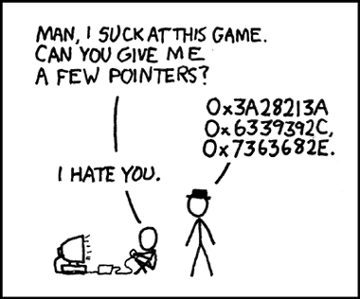 by Randall Munroe
:::
[^believe]: Believe me, if there were a way to teach ROOT/C++
without using pointers, I'd do it. I know the concept is an
additional barrier to understanding C++ for those who've
only been exposed to Python.
You also have to use pointers to take advantage of [object
inheritance](https://www.programiz.com/cpp-programming/inheritance)
and
[polymorphism](https://www.w3schools.com/cpp/cpp_polymorphism.asp)
in C++. ROOT relies heavily on object inheritance (some would say
too heavily), and this is often reflected in the code it
generates.
At this stage, I'll suggest something that, as a scientist,
you're naturally reluctant to do: Take my word for it. Once
you fully understand the object/pointer distinction and what
pointers can be used for, you'll appreciate the memory
management that pointers offer. The automated memory management
of languages like Python and Java superficially makes it
easier to write code, but imposes limitations for advanced programming
techniques.
by Randall Munroe
:::
[^believe]: Believe me, if there were a way to teach ROOT/C++
without using pointers, I'd do it. I know the concept is an
additional barrier to understanding C++ for those who've
only been exposed to Python.
You also have to use pointers to take advantage of [object
inheritance](https://www.programiz.com/cpp-programming/inheritance)
and
[polymorphism](https://www.w3schools.com/cpp/cpp_polymorphism.asp)
in C++. ROOT relies heavily on object inheritance (some would say
too heavily), and this is often reflected in the code it
generates.
At this stage, I'll suggest something that, as a scientist,
you're naturally reluctant to do: Take my word for it. Once
you fully understand the object/pointer distinction and what
pointers can be used for, you'll appreciate the memory
management that pointers offer. The automated memory management
of languages like Python and Java superficially makes it
easier to write code, but imposes limitations for advanced programming
techniques.