PHYSICS C1494 and C2699
Welcome to the home page for the Spring '03 courses "Introduction to Experimental Physics" (Physics C1494) and "Experiments in Classical and Modern Physics", taught by Prof. W.A. Zajc. I will use this page to announce various course-related information.
Description: This 'course', that is, the lecture, will review the physics of the laboratory scheduled for that week, and provide you with the background material, hints and suggestions you will need to complete the laboratory in the allotted 3 hours.
The lecture + laboratory course is designed to
How to reach me: My office hours are by appointment; that's so you can be sure of finding me. There's lots of contact information on my home page, my preferred mode (other than in person) is by e-mail at zajc@nevis.columbia.edu. I am on campus Tuesdays, some Mondays and some Fridays.
Lectures: Tuesday, 3:10-4:00 pm, 329 Pupin.
Text: There is no formal text for the course, but it is very important that you read the lab manual (and perform any required pre-lab exercises) before coming to the lab.
Lab Notebooks: As discussed in the first lecture, you should purchase a bound notebook in which you record all of your work during each laboratory (if you also want to use this for your lab lecture notes, that's fine). My personal recommendation is a spiral bound notebook that lies flat and open on the lab bench. I strongly recommend that you find one with pages that are "quadrille ruled" in some convenient grid (in the U.S., a 1/4 inch grid is common). This is very convenient for making quick graphs while you are taking the data, which in turn is a very convenient way to make sure that your table of measurements isn't completely crazy.
The word "bound" is emphasized above. No loose-leafs, no scrap paper "I'll write this stuff up later". (Exceptions will be made if you need some special form of graph paper during the lab, but this should then get attached to a page in your notebook asap.)
Lab Write-Ups and Grading: Will be based on your laboratory reports, your lab book, and your T.A.'s assessment of your performance in the lab. Some details:
Lab Sections: This lab is offered during the following times:
In the second lab lecture (on Tuesday, Jan. 28th) you will be asked to select three of these times for you lab section (ranked in priority order). The department will make every effort (but cannot guarantee) that you receive you first choice. The lab section assignments will be posted on the bulletin boards on the 5th floor of Pupin in the afternoon of Friday, January 31st.
Lab Setups: If you are interested in testing out the apparatus before a given lab, or need to confirm some results you obtained in a previous lab, you can do this by going to Room 506 in Pupin. There will either be a set-up of the apparatus for each lab there, or directions as to where such a test set-up can be found.
Lab Section Assignments: are available here.
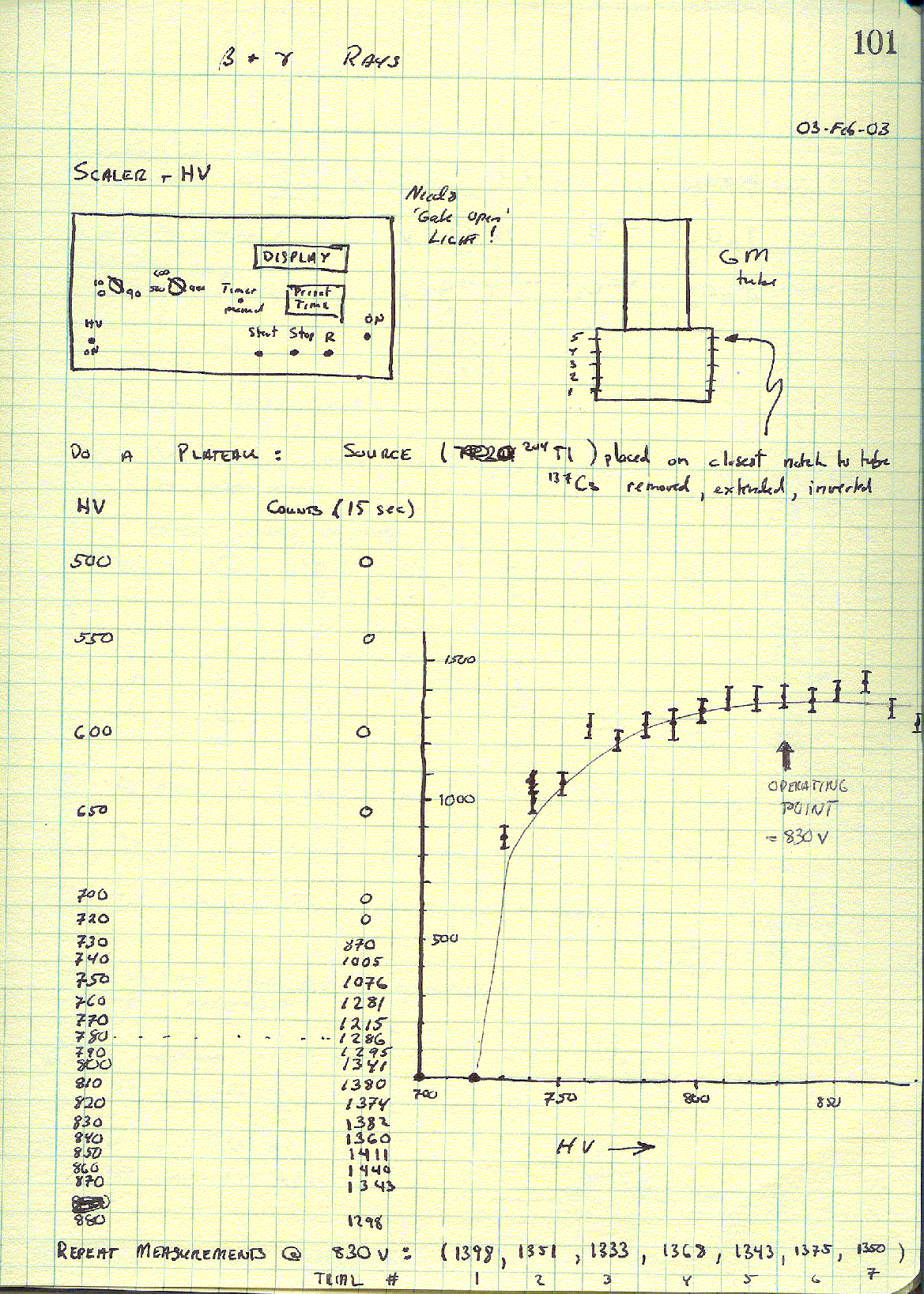
Week of Feb. 3rd: Absorption of Beta and Gamma Rays
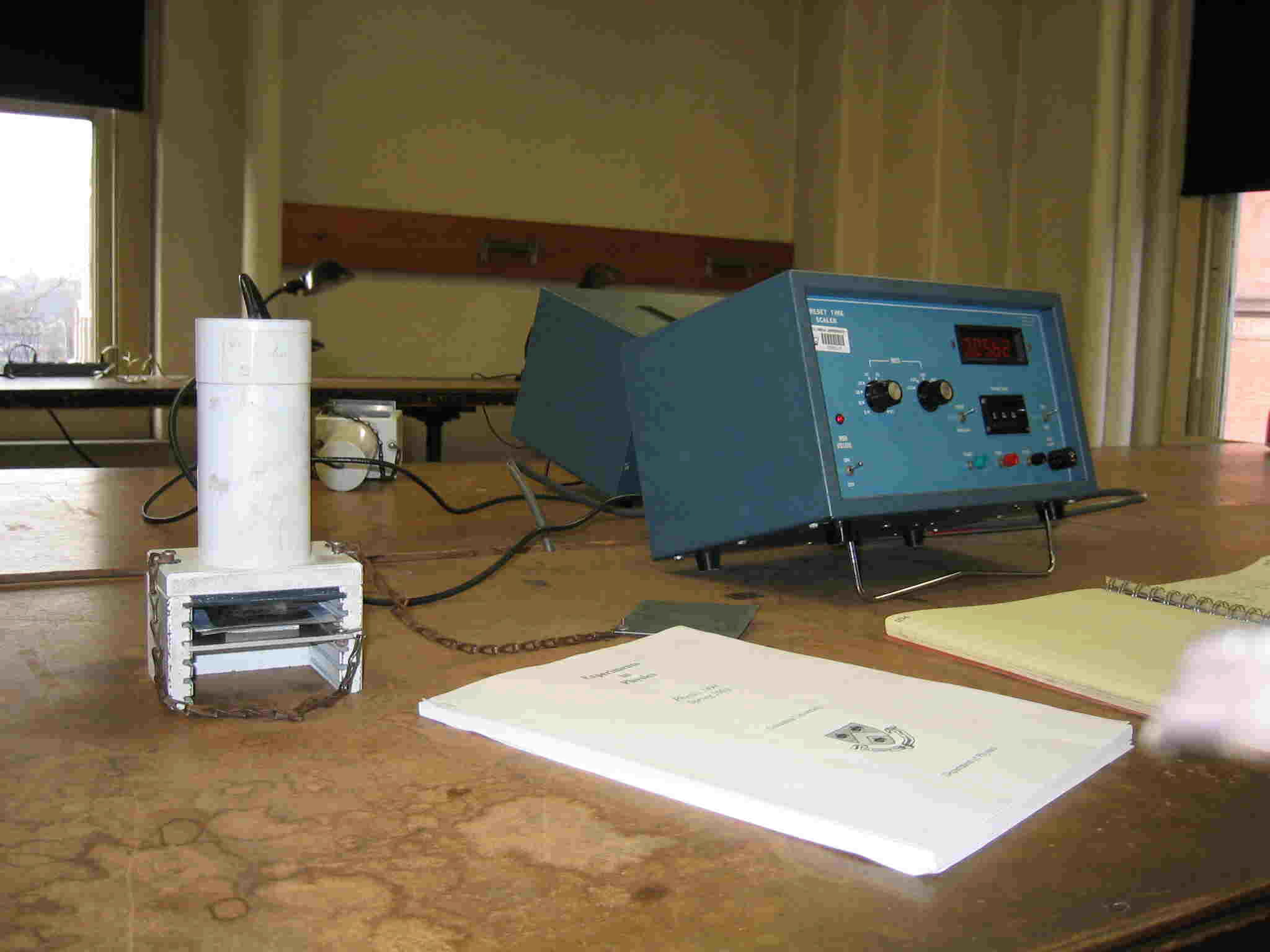
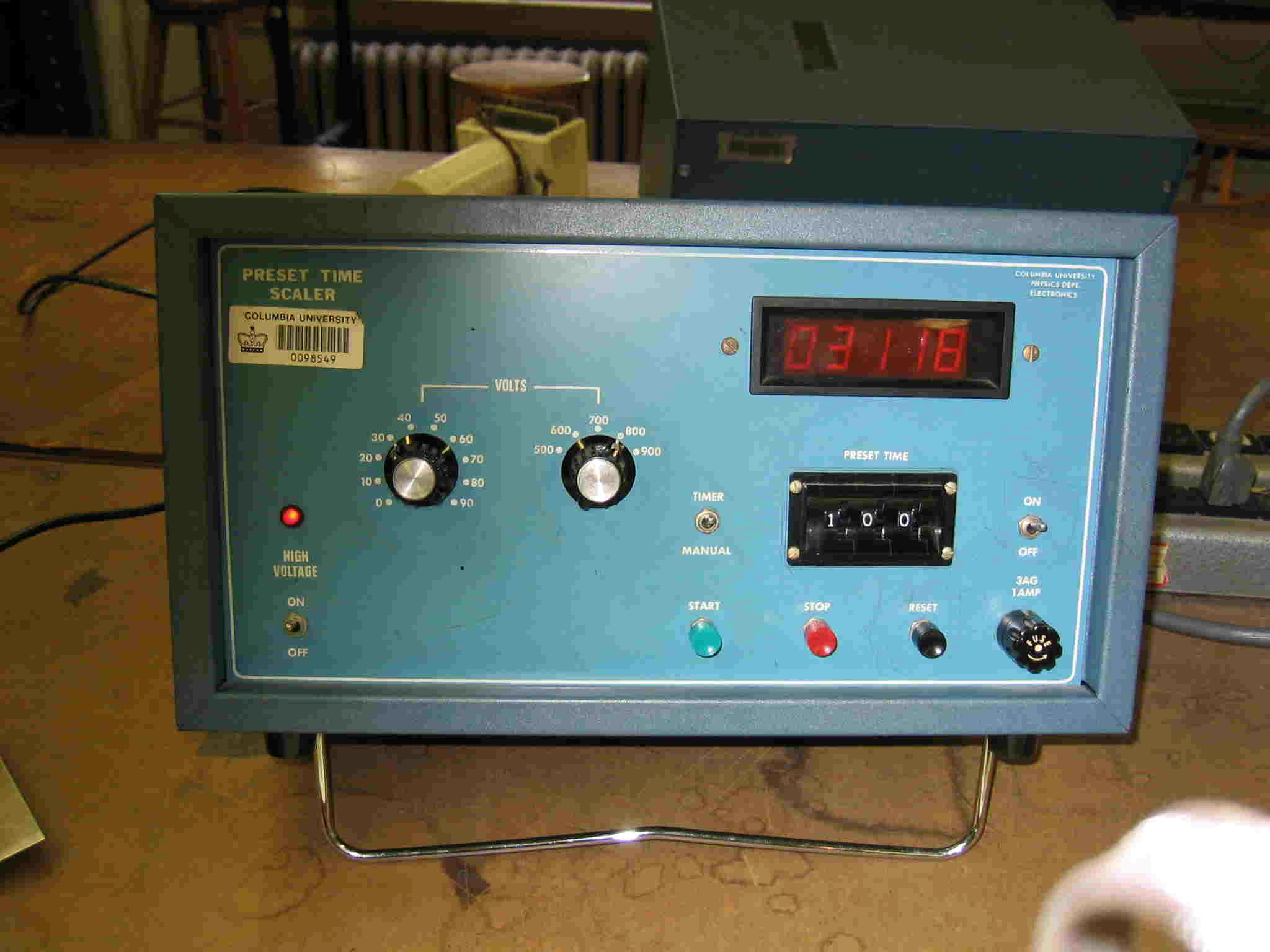
It will help a lot of you come to this class understanding error propagation (to be discussed in 04-Feb-03 lecture). We will supply you with the semi-log graph paper you need to plot the various distributions that you will measure. If you can't wait for the lab to start, here is what it look likes with the 204Tl source in place together with a few sheets of aluminum absorber. A better view of the high voltage supply and scaler is here.
Here's some useful references:
(Excel makes mediocre semi-log plots, and its fitting skills are marginal at best. We'll discuss this in class.)
Week of Feb. 10th: Projectile Motion and Conservation of Energy
It is essential that you come to class having worked out the required formula to predict the range of the projectile. I will go over this a bit in class on Tuesday the 11th. When you're in the lab, you should have this programmed in your calculator or in a spreadsheet, as you will need to evaluate it several times in class.
Week of Feb. 17th: Velocity, Acceleration and g
Week of Feb. 24th: Electric Fields
I've made some web pages that show the results of using Excel to calculate the electric potential for various configurations of conductors.
You can see several things from these plots:
In all cases, I've done the calculation with the entire region surrounded by a grounded box (note the 0's running around the perimeter of each region). This is important. Why? (to be answered in class on the 25th.)
Week of March 3rd: e/m of the Electron
Here are some notes about Helmholtz coils; here is the Mathematica notebook used to generate them.
Week of March 10th: Magnetic Fields
Here are some remarks on this lab:
Week of March 24th: Geometric Optics
Here is a supplement to the lab write-up which should help you get started, and which tells you which sections to do and which ones to skip.
There are many places to find Java Applets that illustrate basic physics concepts. Geometric optics is particularly well suited for this.
From the UW-Stout site:
Geometric Optics
Refraction of Light, Converging Lens, Diverging Lens, Diverging Mirror, Total Internal Reflection, Light Through a Glass Prism , Light Through a Glass Slab, The Rainbow, Thick LensHere is a collection of collections that has an optics collection.
Here is another good optics collection.
I'm sure you can Google your way to many more.
Week of March 31st: Photoelectric Effect
This lab is very straightforward; you can easily collect the minimally useful data in an hour or so and determine Planck's constant to ~30% accuracy.
However, you can learn much more about the nature of errors (and protect yourself from flakey lab equipment, transcription errors, gotchas, etc.) by investigating how your data depends on the apparatus. It is particularly easy to swap the meters used to Vs ; you may be surprised at how large the variation between "equivalent" meters can be. You can of course also do this for the 5-0-5 meters and the amplifier modules. (Make sure you know how to put it back together-- that's why swapping is the best way to proceed.)
The photoelectric effect is all around you. Here is a nice link explaining how it used (sort of) in digital cameras.
At the same time, the lack of the photoelectric is also all around you. It is a very good thing that h
n at GHz frequencies (think of microwave ovens, cell phones, etc.) does not come close to the threshold for ionization. There are qualitative differences in the (large) risks associated with exposure to ionizing radiation and the (small to non-existent) risks from exposure to non-ionizing radiation (which is coursing through your body as you read this, unless you printed it out on paper and are reading inside a conducting box illuminated by a candle). Here is a page from the EPA explaining this.
Week of April 7th: AC Circuits and the Oscilloscope
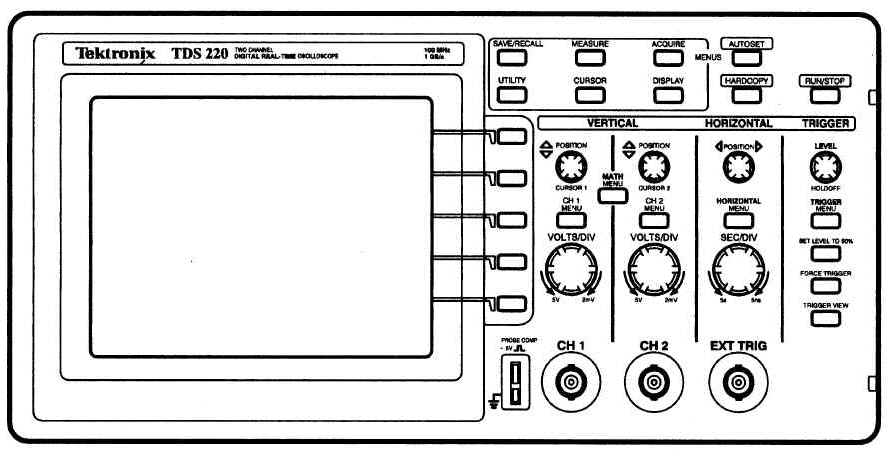
Well, the most important thing is to have the right picture for the scope you will actually be using. Here it is:
The knobs you will use most often are the "Volts/Div" for each channel, the "Trigger Level" know. The two great buttons that make life with a digital scope so great are the "Autoset" and "Measure" buttons. Note that in many cases the vertical row of buttons immediately to the right of the screen allow you to make selections that directly affect what is being displayed.
Here is the complete manual (in PDF format, 1 MB).
Some important notes on this lab:
Week of April 14th: Diffraction and/or Polarization
Please do one more (fun) thing with polarizers in this lab:
I find the re-emergence of transmission by insertion of a completely passive element very impressive. Of course it has a 'trivial' explanation in terms of components of the E-field. But if you allow that individual photons have polarization, it almost forces you into quantum mechanics...
Week of April 21st: Interferometer
Week of April 28th: The Spectrum of the Hydrogen Atom
I added some notes on the error analysis for this lab here. I would like you to apply all that you've learned to determine with some rigor how close your "integers" in the Balmer formula are to true integers, i.e., are their deviations about what you'd expect from the observed and/or estimated measurement errors?