|
|
Neutrino physics
- The Neutrino and its friends are one of the fundamental particles which make up the universe. They are also one of the least understood. Neutrinos are similar to the more familiar electron, with one crucial difference: neutrinos do not carry electric charge. Because neutrinos are electrically neutral, they are not affected by the electromagnetic forces which act on electrons. Neutrinos are affected only by a "weak" sub-atomic force of much shorter range than electromagnetism, and are therefore able to pass through great distances in matter without being affected by it. If neutrinos have mass, they also interact gravitationally with other massive particles, but gravity is by far the weakest of the four known forces.
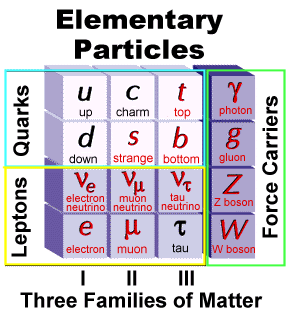
- Three types of neutrinos are known; there is strong evidence that no additional neutrinos exist, unless their properties are unexpectedly very different from the known types. Each type or "flavor" of neutrino is related to a charged particle (which gives the corresponding neutrino its name). Hence, the "electron neutrino" is associated with the electron, and two other neutrinos are associated with heavier versions of the electron called the muon and the tau (elementary particles are frequently labelled with Greek letters, to confuse the layman). Click here for a list of the known types of neutrinos (and their electrically charged partner). For more information, see Neutrino History and Main Contributors.
- For more than three decades, underground experiments measuring the flux of neutrinos from the Sun have found a significant deficit in the observed rate compared to the predictions of the Standard Model (SM). A possible explanation for this discrepancy is that neutrinos produced in the core of the Sun are modified along their path to Earth, transforming into another neutrino species via neutrino oscillations. The next major goal of solar neutrino astronomy is to measure neutrino fluxs in low energy region less than 1MeV, and in particular to measure the flux from the dominant pp reaction, which peaks in the range of 200-300 keV. It would be very desirable to measure also the energy spectrum of the scattered electrons produced by neutrino interactions. They will provide a simultaneous and critical test of stellar evolution and of neutrino oscillations. For more information, see Neutrino Oscillation Industry.
|

 Contacts
 E-mail
 Phone/fax
 Mail
Mail Where
Where